ImageSquid
Believe your eyes
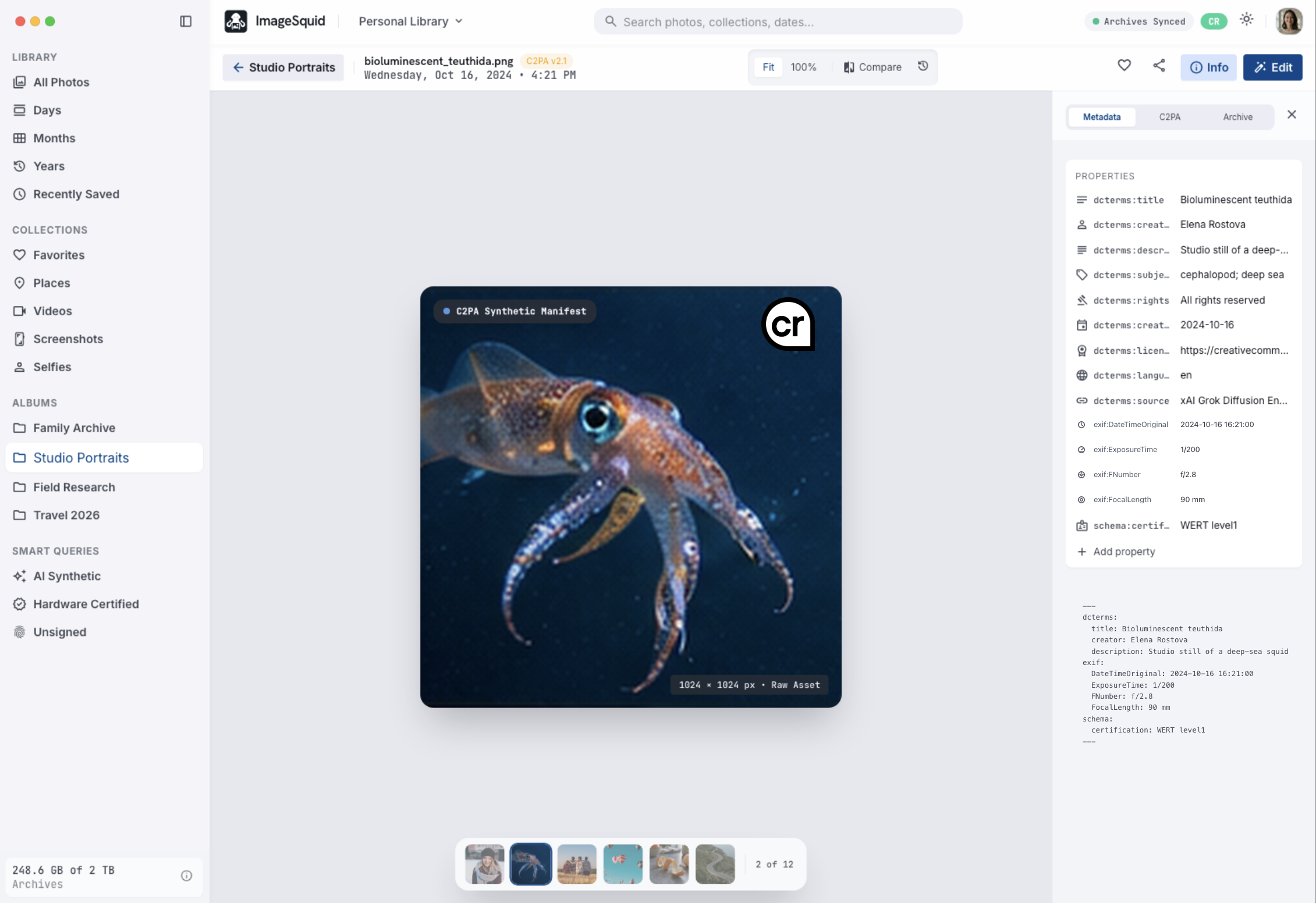
ImageSquid is a local-first photo manager that exists to help people reclaim control of their visual memories, while providing clarity on AI use via full C2PA support.
Your library, your rules.
 Media ownership
Local first, yours to keep.
Media ownership
Local first, yours to keep.
The ImageSquid library lives on your computer, works offline, and leaves with you.
Your images matter. So do the descriptions, dates, edits, relationships, organization, and source context you have spent years bringing together and giving rich meaning to your image collections. ImageSquid keeps that meaning with the files, not trapped on someone else's online platform. Originals, edits, and metadata stay exportable if you quit the app or the hosted service.
Independent ownership should be convenient, too: a fast, capable way to find, enhance, enjoy, and share a collection across devices and operating systems. ImageSquid pairs the everyday ease of an app like Apple Photos with cross-platform ownership, reliable migration, and institutional-grade backup. One library can be synced and used on Windows, macOS, and Linux desktops, in the online web app, and on mobile web.
To get you started, ImageSquid can bulk-import from most major commercial photo-management platforms. Moving a full library can take a while, because of network and computing limits, so ImageSquid import recovers from errors, picks up where it left off without starting over, and runs quietly in the background. It does this without blocking or locking active use of the app, and every file is copied at 100% fidelity.
 Data portability
Free to move. Easy to leave.
Data portability
Free to move. Easy to leave.
You can leave a hosting provider, work offline, recover from mistakes, and leave ImageSquid — the app and any optional sync/backup service — at any time, without losing original media, later enhancements, or metadata enrichment.
This is based heavily on the PDS (Personal Data Server) concept used by the decentralized Bluesky social network and its AT Protocol.
On disk, ImageSquid files are archival OCFL objects (Oxford Common File Layout). Export tools make a convenient bulk copy of the library. From that OCFL bundle you can start a fresh copy of ImageSquid, browse and navigate the collection with your own filesystem tools, or build new applications on top of the OCFL object store.
 Free and open source
Free to use. Built in the open.
Free and open source
Free to use. Built in the open.
ImageSquid's MIT open-source license means the code is there to inspect for security and privacy, to accept contributions from the community, and to integrate legally into existing architectures and commercial platforms.
ImageSquid is built as one Rust-based core library that can be installed for free across Linux, macOS, Windows, and the web.
Optional paid add-ons from ImageSquid.app:
- Encrypted sync across devices
- Encrypted backup at rest for media library
- C2PA certificate publication
This approach is similar to Obsidian's freemium model: the app is free, and syncing is a paid service. The difference is the license. Obsidian is free but closed source. ImageSquid's MIT license means any organization or company can build its own sync and backup services instead of using the ones from ImageSquid.app.
 C2PA provenance
Believe your eyes. Industry-standard disclosure.
C2PA provenance
Believe your eyes. Industry-standard disclosure.
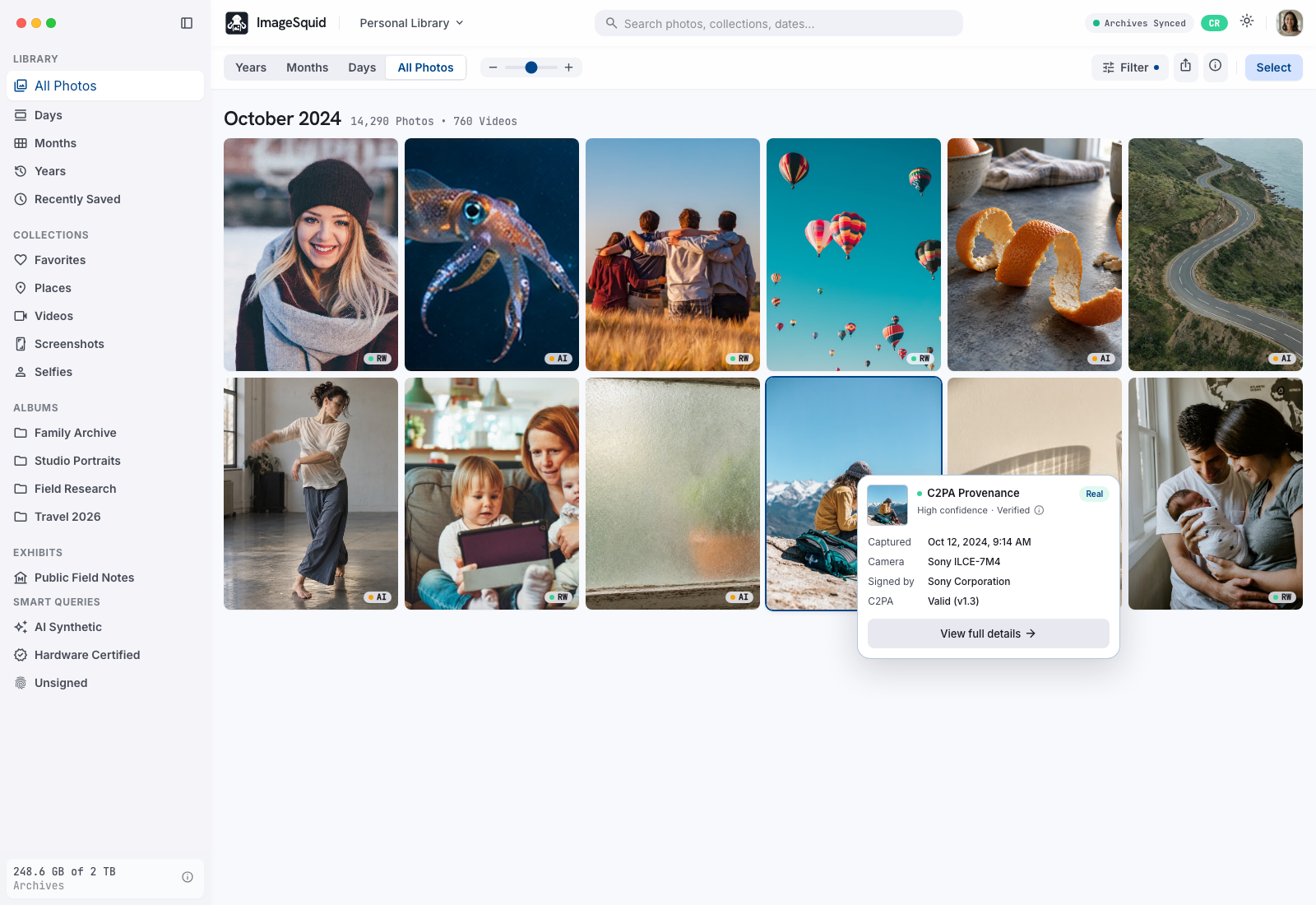
Provenance is how a collection verifies a picture's origins and that it is what it claims to be.
C2PA Content Credentials are an open standard for signed, file-bound statements about image provenance.
Every ImageSquid import starts a durable C2PA record per image. These records disclose human-generated content, AI-generated content, or a combination of both. Prior credentials, generator marks, and ImageSquid's later actions remain auditable by that industry-standard method.
Signed statements travel with the file. Free collection scans report missing, unsigned, and AI-touched items before you share. If you need to share or publish an image with a third-party signed, certified C2PA watermark, ImageSquid.app is able to provide this integrated service at a small fee.
ImageSquid also implements the W3C PROV-O PROVenance Ontology, a widely used vocabulary for recording who did what to which resource; providing audit trails that are both human and machine-readable.
ImageSquid's C2PA and PROV-O records underpin components used to detect AI deepfakes and make image creation and processing more transparent.
 Bring your own AI
Your models. Your provider. Your privacy.
Bring your own AI
Your models. Your provider. Your privacy.
The AI models behind ImageSquid's features are fully your choice, not dictated by your photo platforms. This means ImageSquid leaves no fears about the privacy of your image content and activities.
This is a "bring-your-own (BYO) inference" model: use a local AI model runner or your own frontier provider account (e.g. Claude, ChatGPT, Grok, etc). You pay that provider. ImageSquid does not sell inference, and backup never sees your network traffic; of course the commercial AI companies will read and likely store your original, prompts and outputs if you choose that option.
The more private alternative is to connect a local open-source model and runner, eg. Gemma4 with llama.cpp, through the industry-standard OpenAI API format.
Everyday use and performance of the ImageSquid interface stays within reach while your AI processing work runs in background jobs.
 Long-term access
A professional archive, without becoming an archivist.
Long-term access
A professional archive, without becoming an archivist.
Professional, open archival formats keep originals and their context recoverable into the indefinite future, independent of the app.
Files on disk are the canonical source. ImageSquid stores them as OCFL (Oxford Common File Layout) objects — the layout professional archives use for versioned files and inventories. Archival standards are meant to maintain long-term access and usability for digital files.
This means you don't need a specific proprietary or open-source application to read your ImageSquid data, now or in the future. You can inspect a completed library with ordinary file tools and rebuild it in full if the application or its indexes are corrupted or removed.
Provenance stays with that archive, represented in metadata sidecars containing C2PA, PROV-O, EXIF, Dublin Core and Schema.org records. Each metadata file lives in the OCFL object for the image it describes, where it can be indexed, searched, and used to judge findability, usability, and trustworthiness, including in preservation risk assessments as operating systems, applications, and preferred formats change.
Users can add other professional vocabularies and future releases will add support for more professional archival standards such as PREMIS.
ImageSquid brings professional archival design into everyday image management, without requiring you to become an archivist or a system administrator.